
News Item
Fighting Corruption in the Courtroom: Insights from Montenegro

- Issued on:
- Issued by:
- OSCE Mission to Montenegro
- Fields of work:
- Rule of law
As the famous legal maxim states, where there is society, there is law (Ubi societas, ibi ius). And, in addition, where there is law, there are those who uphold the law. From Roman praetors to today's judicial institutions, justice was served by individuals who hold wrongdoers accountable. The International Anti-Corruption Day serves as a valuable reminder.
Monitoring organized crime and corruption cases
The OSCE Western Balkans Trial Monitoring Project was invited to Montenegro and five other jurisdictions to follow cases of organized crime and corruption in both the public and private sectors, assessing the judicial response to these cases.
One of the dimensions through which the Project assesses the judicial response to cases of organized crime and corruption is the capacity of justice sector actors, including judicial accountability.
In Montenegro, judicial accountability is often perceived as being strictly institutional and regulatory, due to the various key performance indicators judges must be held accountable to when performing their duties. However, it is with the uniquely diagnostic lens of trial monitoring that the core nature of judicial accountability can be seen. Precisely, the accountability of judges is directly observed in the courtroom through judges' efforts to ensure an effective response to corruption cases – the best tool for preventing corruption.
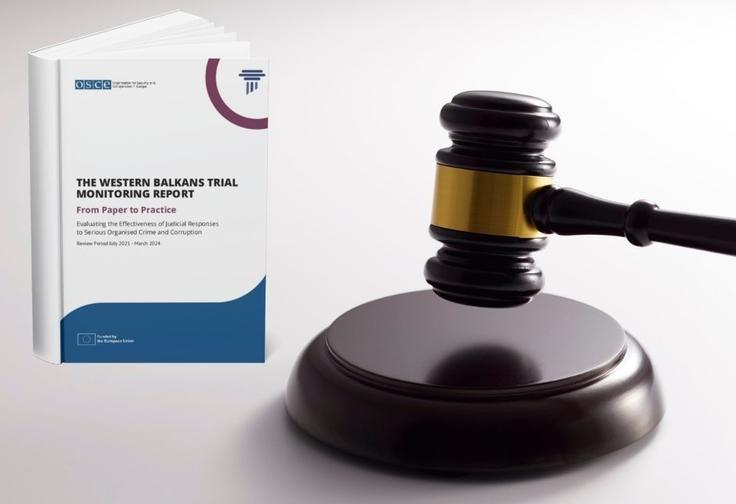
The Western Balkans Trial Monitoring Report was issued in June 2024.
The link between judicial accountability and anti-corruption
Judicial accountability is rooted in ethics, while corruption tries to defy ethics. Ethics underscores the very purpose of fighting corruption: a moral duty to do what is right and honest. It is a judge's ethical commitment that makes a difference. Ethics fuels the intrinsic reason why judges should appear in court each day and uphold the rule of law.
The Trial Monitoring Project focuses on documenting acts of professional integrity in assessing the response to organized crime and corruption cases. For instance, teams across the region, including in Montenegro, observed good practices of judges in overcoming regulatory gaps, institutional difficulties, and various parties' pleadings. This sometimes requires deep commitment in terms of holding hearings outside the premises of the court (in another court), scheduling several hearings in advance in order to ensure the presence of the parties, and providing immediate medical expertise when needed. All of these are moves that individual judges make in order to make sure that justice is served.
While work continues on the overall judicial response to corruption cases, trial monitoring captures important shifts that signal progress. For instance, when a judge’s reasoning on the sentencing decision reflects an understanding of corruption’s broader societal impact, this represents an effective judicial response to corruption.
Way forward in bridging judicial accountability and the fight against corruption
The general shift in judicial accountability isn't something that can be fully overcome with harsher regulation or a more rigid disciplinary procedure. Judges are essential carriers of justice in society. They are the ones who hold corrupt offenders responsible for their actions. Without judges who hold themselves accountable, existing or even improved accountability mechanisms will ultimately not bring about lasting change.
This is what makes fighting corruption and judicial accountability strongly interlinked: the inherent duty to do right, with that being a goal in itself, not any external acknowledgment. A society that rests in the hands of judges with professional and personal integrity will consequently hold accountable those members of society without integrity or ethical considerations.
By following the shifts that happen within judges, trial monitoring adds value through revealing that even seemingly small actions can lead to a better judicial response to corruption. Because, ultimately, corruption cannot take root in soil nourished by integrity and a steadfast commitment to accountability. And this is what makes a society flourish.
Alida Radončić, National Trial Monitoring Officer
OSCE Mission to Montenegro
Contact
